
Protein Molecular Weight Markers


S2 Media 15x100mm Chameleon™ COLOREX™ C3GR (RUO), 10/pack
Chameleon™ COLOREX™ C3GR (RUO) is a selective and differential, chromogenic culture medium used for the qualitative direct detection of gastrointestinal colonization with 3rd generation cephalosporin-resistant Enterobacteria (C3GR-E). Test specimens include rectal swabs and stools. For Research Use Only (RUO). Not for use in diagnostic procedures unless Laboratory Developed Test (LDT) validation with the product has been completed. Further identification, susceptibility testing, and epidemiological typing should be performed on suspect colonies.• Product meets CLSI performance criteria.• Chameleon™ COLOREX™ C3GR should be used by trained professionals within a laboratory setting. • For in vitro diagnostic (IVD) use.• Product is not intended for use in the diagnosis or treatment of disease or other human conditions.

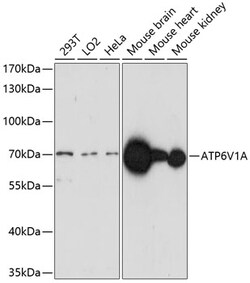
ABclonal Technology ATP6V1A Rabbit pAb

This gene encodes a component of vacuolar ATPase (V-ATPase), a multisubunit enzyme that mediates acidification of eukaryotic intracellular organelles. V-ATPase dependent organelle acidification is necessary for such intracellular processes as protein sorting, zymogen activation, receptor-mediated endocytosis, and synaptic vesicle proton gradient generation. V-ATPase is composed of a cytosolic V1 domain and a transmembrane V0 domain. The V1 domain consists of three A and three B subunits, two G subunits plus the C, D, E, F, and H subunits. The V1 domain contains the ATP catalytic site. The V0 domain consists of five different subunits a, c, c, c", and d. Additional isoforms of many of the V1 and V0 subunit proteins are encoded by multiple genes or alternatively spliced transcript variants. This encoded protein is one of two V1 domain A subunit isoforms and is found in all tissues. Transcript variants derived from alternative polyadenylation exist.
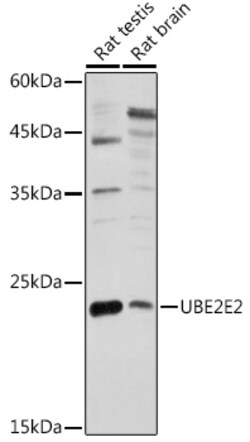
ABclonal Technology UBE2E2 Rabbit pAb
Enables ISG15 transferase activity and ubiquitin conjugating enzyme activity. Involved in protein modification by small protein conjugation. Acts upstream of or within cellular response to DNA damage stimulus and positive regulation of G1/S transition of mitotic cell cycle. Predicted to be active in nucleus.
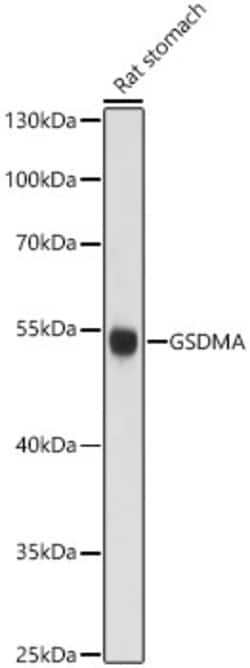
ABclonal Technology Gsdma Rabbit pAb
Predicted to enable phosphatidylinositol-4,5-bisphosphate binding activity, phosphatidylinositol-4-phosphate binding activity, and phosphatidylserine binding activity. Predicted to be involved in apoptotic process, defense response to bacterium, and pyroptosis. Predicted to act upstream of or within programmed cell death. Located in cytoplasm. Is expressed in esophagus epithelium, stomach, stomach cardiac region, stomach glandular region, and stomach glandular region mucosa. Orthologous to human GSDMA (gasdermin A).
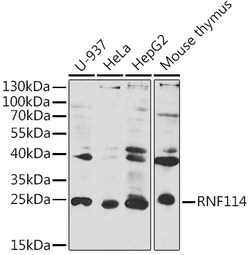
ABclonal Technology RNF114 Rabbit pAb
Predicted to enable ubiquitin protein ligase activity. Predicted to be involved in protein polyubiquitination and ubiquitin-dependent protein catabolic process. Located in cytosol and plasma membrane. Biomarker of male infertility.
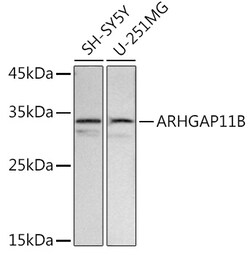
ABclonal Technology ARHGAP11B Rabbit pAb
Predicted to enable GTPase activator activity. Involved in cerebral cortex development and negative regulation of mitochondrial membrane permeability. Acts upstream of with a positive effect on glutamine catabolic process. Located in mitochondrial matrix.
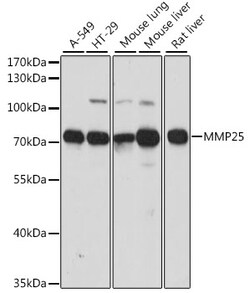
ABclonal Technology MMP25 Rabbit pAb
Proteins in the matrix metalloproteinase (MMP) family break down the extracellular matrix in processes like development, tissue remodeling, and disease progression, including arthritis and metastasis. Most MMPs are secreted as inactive proproteins, activated by extracellular proteinases. This gene encodes a membrane-type MMP (MT-MMP), anchored to the plasma membrane via a glycosylphosphatidylinositol anchor. In response to infection or inflammation, the protein inactivates alpha-1 proteinase inhibitor, aiding neutrophil migration to inflammation sites. It may also contribute to tumor invasion and metastasis by activating MMP2. The gene, formerly known as MMP20, is now renamed MMP25.
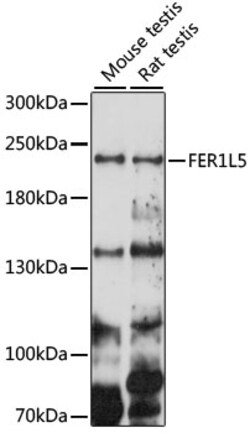
ABclonal Technology FER1L5 Rabbit pAb
Predicted to enable calcium ion binding activity and calcium-dependent phospholipid binding activity. Predicted to be involved in several processes, including myeloid cell activation involved in immune response, negative regulation of phagocytosis, and plasma membrane organization. Predicted to be located in plasma membrane. Predicted to be integral component of membrane. Predicted to be active in T-tubule and cytoplasmic vesicle.
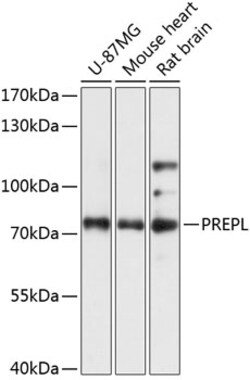
ABclonal Technology PREPL Rabbit pAb
The protein encoded by this gene belongs to the prolyl oligopeptidase subfamily of serine peptidases. Mutations in this gene have been associated with hypotonia-cystinuria syndrome, also known as the 2p21 deletion syndrome. Several alternatively spliced transcript variants encoding either the same or different isoforms have been described for this gene.
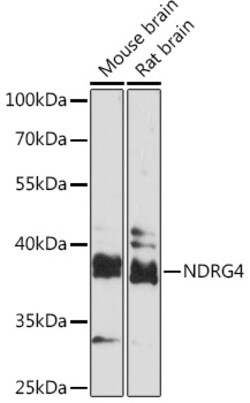
ABclonal Technology NDRG4 Rabbit pAb
This gene is a member of the N-myc downregulated gene family which belongs to the alpha/beta hydrolase superfamily. The protein encoded by this gene is a cytoplasmic protein that is required for cell cycle progression and survival in primary astrocytes and may be involved in the regulation of mitogenic signalling in vascular smooth muscles cells. Alternative splicing results in multiple transcripts encoding different isoforms.

S2 Media 15x100mm Chameleon™ COLOREX™ (O)rientation - Opaque, 10/pack
Chameleon™ COLOREX™ (O)rientation is a non-selective, differential, chromogenic culture medium used for the qualitative direct detection and presumptive identification of uropathogens associated with urinary tract infections (UTI). Test specimens include urine. Concomitant cultures should be performed to recover organisms for further microbiological testing or epidemiological typing. Further identification, susceptibility testing, and epidemiological typing should be performed on suspect colonies.• This formulation has been supplemented to be OPAQUE and off-white in color. (Material #5185 is clear to trace hazy and light amber in color.) • Product meets CLSI performance criteria.• Chameleon™ COLOREX™ (O)rientation should be used by trained professionals within a laboratory setting. • For in vitro diagnostic (IVD) use.• Product is not intended for use in the diagnosis or treatment of disease or other human conditions.
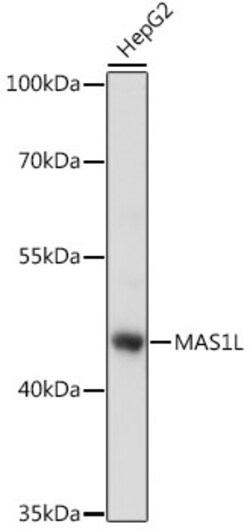
ABclonal Technology MAS1L Rabbit pAb
Predicted to enable G protein-coupled receptor activity. Predicted to be involved in G protein-coupled receptor signaling pathway. Located in cytosol, nucleoplasm, and plasma membrane.
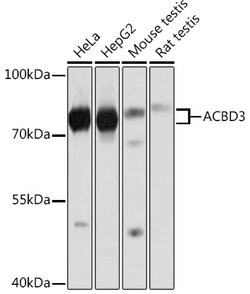
ABclonal Technology ACBD3 Rabbit pAb
The Golgi complex plays a key role in the sorting and modification of proteins exported from the endoplasmic reticulum. The protein encoded by this gene is involved in the maintenance of Golgi structure and function through its interaction with the integral membrane protein giantin. It may also be involved in the hormonal regulation of steroid formation.
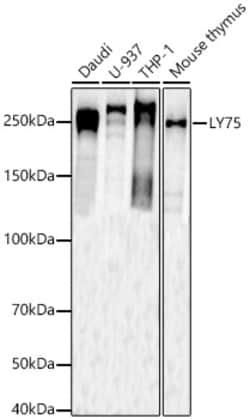
ABclonal Technology LY75 Rabbit pAb
Predicted to enable signaling receptor activity. Predicted to be involved in immune response and inflammatory response. Located in extracellular exosome.
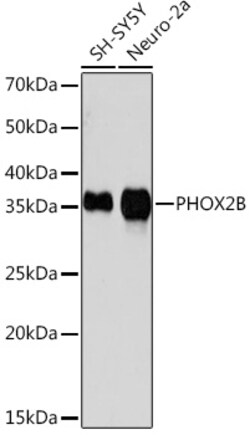
ABclonal Technology PHOX2B Rabbit mAb
The DNA-associated protein encoded by this gene is a member of the paired family of homeobox proteins localized to the nucleus. The protein functions as a transcription factor involved in the development of several major noradrenergic neuron populations and the determination of neurotransmitter phenotype. The gene product is linked to enhancement of second messenger-mediated activation of the dopamine beta-hydroylase, c-fos promoters and several enhancers, including cyclic amp-response element and serum-response element. Expansion of a 20 amino acid polyalanine tract in this protein by 5-13 aa has been associated with congenital central hypoventilation syndrome.